Skull Anatomy for Artists: Understand Head Shape

If you’ve ever struggled to make a head look convincing, the problem usually traces back to skull anatomy. The skull determines head shape – muscles, fat, skin, and hair all sit on top of it, but the underlying bone structure comes first.

In this article, we’ll look at the main bones of the skull and the landmarks every artist should know for understanding head shape. The information is based on our in-depth Head Anatomy video tutorial, in which Uldis Zarins walks you through this material in full video detail.

Share post:

Skull anatomy for artists – main

Uldis Zarins explaining anatomical landmarks of various skulls on his Head Anatomy video tutorial.

Table of contents

Braincase and Facial Skeleton: The Two Parts of the Skull

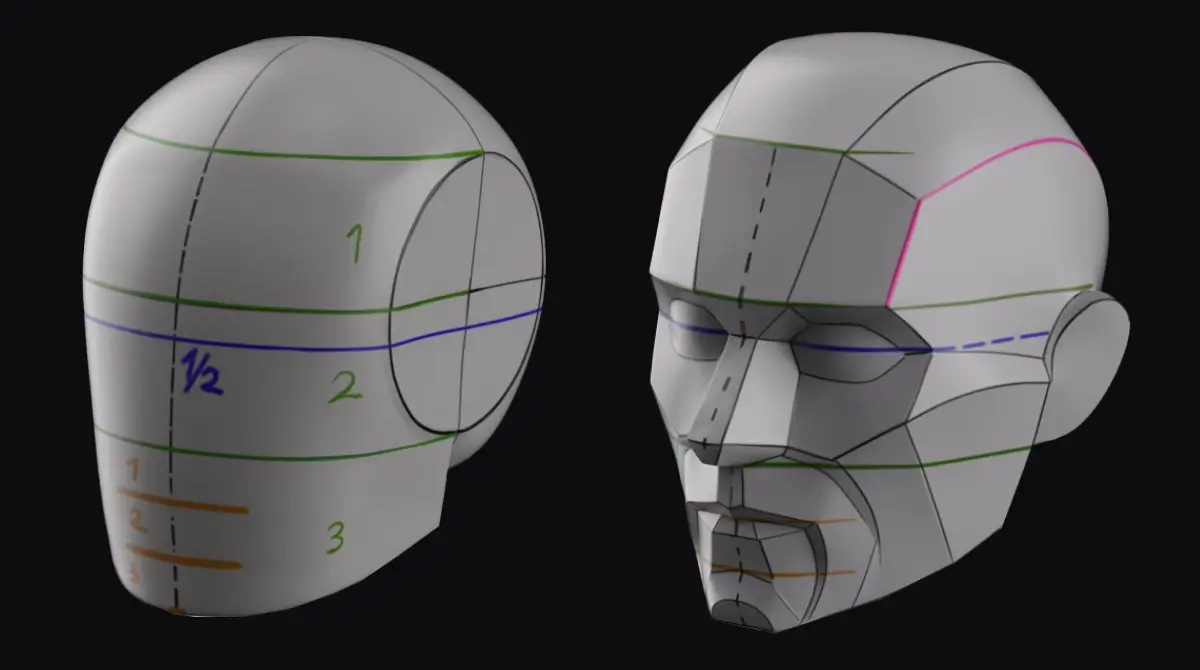
Artists often divide the skull into two large regions: the braincase (neurocranium), which surrounds the brain, and the facial skeleton (viscerocranium), which forms the front of the face. The braincase is large, rounded, and egg-shaped, while the facial skeleton is almost like a cylinder in front of it. For artistic purposes, a simple rule is enough – the boundary between the two lies roughly at eyebrow level.
Skull anatomy for artists – 1

The braincase is egg-shaped, while the facial skeleton is more cylindrical.

In newborns, the difference between these two regions is easy to see. The braincase is large, while the face is relatively small. As the body develops, the face grows faster than the braincase, and the two regions gradually become more proportional to each other.

Skull anatomy for artists – 2

Babies have a disproportionately large braincase, its difference from the facial skeleton is easy to see.

Head Shape: Round, Long, or In Between

Not every skull shares the same proportions. Head shape ranges from broad and round (brachycephalic) to long and narrow (dolichocephalic), with most people falling somewhere in between these two (mesocephalic).

Skull anatomy for artists – 3

Head shape can range from brachycephalic to dolichocephalic, with mesocephalic in between.

These differences affect the head from every angle, not just from above. They influence the width of the face, the proportions of the jaw, and the overall silhouette of the head. There’s no ideal head shape to aim for. The important thing is learning to recognize the differences instead so that you can make your characters look genuinely diverse.

The Bones of the Skull

You don’t need to memorize every bone in the skull, but a handful of them shape the head enough that artists should know them by name.

Skull anatomy for artists – 13

The ten major bones of the skull an artist should know. Image from "Anatomy of Facial Expression" book

Frontal and Parietal Bones

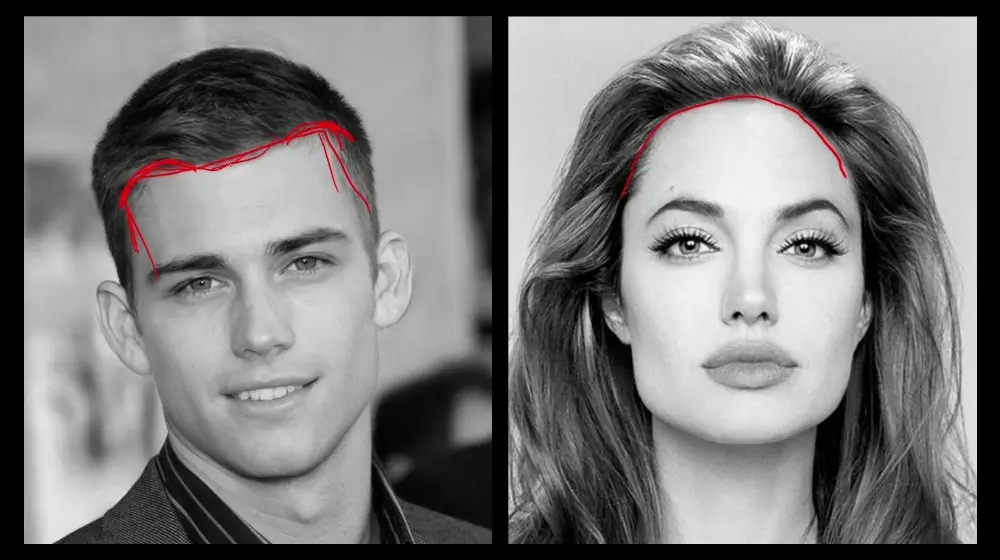
Starting at the top: the frontal bone forms the forehead, the upper orbital rim, and the root of the nose. It sits closer to the skin than any other bones of the skull, so it has the most influence on the visible shapes.

Skull anatomy for artists – 4

The frontal bone's frontal eminences and browridge define the forms of the brows and forehead.

The parietal bones are a pair that make up roughly two-thirds of the skull’s surface, forming most of the top and sides. They join with the frontal bone at the coronal suture. Together, these two bones also define two of the most useful construction landmarks: the widest points of the head and face.

The widest point of the Head and Face

Two landmarks are especially useful during construction: the parietal eminence, the widest point of the head, and the zygomatic arch, the widest point of the face.

Skull anatomy for artists – 5

The parietal eminence is the widest point of the head. 

The parietal eminence sits above the ear on each side of the skull. The zygomatic arch forms where the zygomatic bone meets the temporal bone, passing over the temporalis muscle.

Skull anatomy for artists – 6

Locating the widest point of the head and face.

For most people, the parietal eminence is the single widest point of the head overall, but if the person is very brachycephalic, the zygomatic arch can exceed the width of the parietal eminence. For most people however, it’s usually the second widest point of the head.

Skull anatomy for artists – 7

The zygomatic arch is the widest point of the face.

Cheekbone, Jaw Bones, and the Rest

The zygomatic arch we just covered is formed in part by the zygomatic bone – the cheekbone itself. The zygomatic bone is square-shaped and highly visible, forming part of the eye socket’s outer rim.

Skull anatomy for artists – 9

See how the zygomatic bone appears on the surface of the face.

The maxilla, or upper jaw, supports the upper teeth and forms the inner rim of the socket. It also shapes the upper part of the mouth barrel, the surface that catches light in a portrait. The nasal bones form the upper half of the nose, above where cartilage takes over.

Skull anatomy for artists – 14

Skull, transparent and real person photo example.

At the sides: the temporal bone forms the temple. Most of it is hidden under the temporalis muscle and the ear, but it houses the structures responsible for hearing and balance. Its most interesting feature for artists is that it creates half of the zygomatic arch. The sphenoid bone has no visible surface presence at all, its only job is holding the surrounding skull bones together, almost like a structural core.

Finally, the mandible, or lower jaw, is the only large bone in the skull that actually moves. It features a horseshoe shape and, similarly to maxilla, it holds the lower teeth. However, there’s still much more about the mandible we can explore.

What the Jaw reveals about Age and Gender

The mandible deserves special attention because it carries a lot of information about age and gender, and it has a strong influence on the overall appearance of the face. One of the most important landmarks of the jaw is the gonial angle, where the body of the jaw (purple in the picture below) meets the ramus (marked green).

Skull anatomy for artists – 11

Male gonial angle vs. female gonial angle.

A more pronounced angle with a steeper ramus often creates a stronger and more traditionally masculine appearance. Female jaws feature a wider angle, which produces a softer appearance.

The gonial angle also changes with age. A wider gonial angle is common both in babies and elderly people. This is due to lack of teeth as well as the alveolar processes – the bone structures that support the teeth.

Skull anatomy for artists – 12

Age-related gonial angle changes.

The gonial angle might seem like a small detail at first, but it has a surprisingly big effect on the way the overall shape of a face appears.

The skull is the foundation of head shape. Once you understand its major forms and landmarks – the bones, the widest points of the head and face, and the way bone structure reveals age and gender – the muscles and soft tissue that sit on top of it become far easier to understand and recreate accurately.

This article only scratches the surface of what’s covered in our full Head Anatomy video course, where each of these landmarks is demonstrated on real faces, with more variation and case studies than we can fit into a written guide. If you want to go deeper into skull anatomy for artists, check out the full course here.

Latest articles

forming the head blog for artists 1

Forming the Head: Simple to Complex

Form the head by starting with simple shapes and gradually add structure and detail. We cover base forms like the helmethead and egghead, first- and second-level blockouts, and the anatomy and variation that shape the head.

Read more
3D anatomy models for artists blog

3D Anatomy models for artists

3D Reference Tool is much more than just a library of scans. Here, you will find 3D anatomy references – block-outs, anatomy models, and realistic assets – to help you understand and create realistic human anatomy.

Read more

Join our newsletter

Be the first to get news about our upcoming discounts, books, tools, articles and more! No spam, just the good stuff.