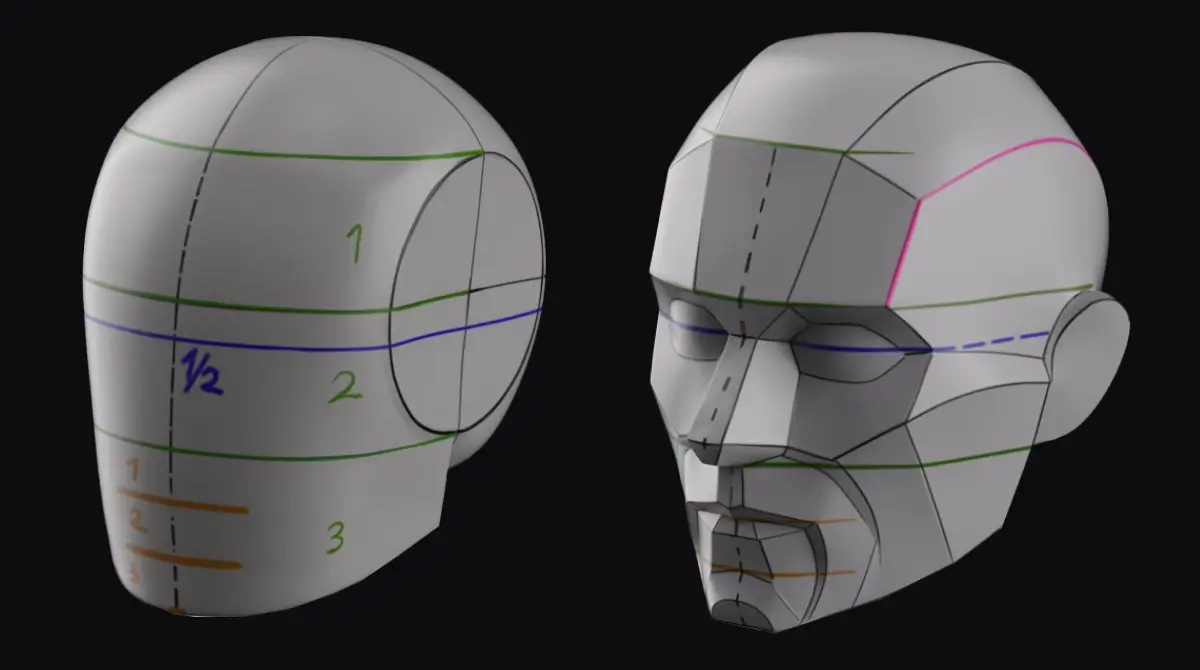
Male vs. Female Forehead: Bone Structure and Hairline

The forehead is one of the most useful areas for artists to study, because it heavily influences how masculine or feminine a face looks. Almost all of its shape comes directly from the frontal bone with very little soft tissue in the way to obscure it, which we looked at in the previous blog on Skull Anatomy.

Share post:

Male and Female Forehead main img

Table of contents

This article breaks down the bone structure behind a male vs. female forehead, including the brow ridge, frontal eminences, and temporal lines. It also features the hairline as a moving landmark. The article is based on our in-depth Head Anatomy video tutorial, in which Uldis Zarins walks through this material on real skulls and faces.

Forehead Anatomy: Brow Ridge vs. Frontal Eminences

Male and Female Forehead img

Male vs. female forehead anatomy.

Two bony landmarks do most of the work determining whether a forehead looks masculine or feminine, and they pull in opposite directions: the brow ridge toward a stronger, more masculine look, and the frontal eminences toward a softer, more feminine one.

Male and Female Forehead img – 1

A male frontal bone with a developed brow ridge and a female one with developed frontal eminences.

Brow ridge as a masculine landmark

The brow ridge consists of the superciliary arches and the glabella, the smooth area between the eyebrows. It is the more masculine of the two landmarks – a prominent brow ridge creates a stronger appearance.

Male and Female Forehead img – 2

Male vs. female brow ridge.

Frontal eminences as feminine landmarks

The frontal eminences are the rounded protrusions located higher on the forehead. They are usually more pronounced in women – the opposite to the brow ridge. They are also more visible in children and give the forehead a softer, rounder profile.

Male and Female Forehead img – 3

Female frontal eminences create a rounded forehead, while male frontal eminences are flat.

A strong brow ridge with faint frontal eminences looks more masculine. Strong frontal eminences with a soft brow ridge look more feminine. However, many men have prominent frontal eminences with a flat brow ridge, and many women have a pronounced brow ridge with less visible frontal eminences – the strict masculine/feminine split is useful for learning the extremes, but real faces mix these features in all kinds of combinations.

Male and Female Forehead img – 4

A comparison of feminine and masculine male foreheads.

The Temporal Line

The temporal line marks the boundary of the temple with the forehead and the roof of the head. It begins near the eyebrow and curves up and back across the side of the head. This is also where the temporal fascia, the connective tissue wrapping the temporalis muscle, attaches to the bone.

Male and Female Forehead img – 5

The temporal line marks the border of the temple with the forehead and the roof of the head.

The temporal line is often easier to see in men and older individuals, since the skin layer in this area becomes thinner with age, but the temporal muscle is still thick enough, especially for older males.

Male and Female Forehead img – 6

A pronounced temporal line on a middle-aged male.

When constructing a head, it helps to identify the temporal line early. However, during refinement, you’ll usually want to soften it, especially when creating females, where a sharp temporal line can read as unintentionally aged or masculine.

Male and Female Forehead img – 7

A woman with a prominent temporal line on the left and a regular invisible temporal line on the right.

The temporal line also influences how the forehead looks as a whole. On men, the temporal lines on either side tend to be sharper, framing the forehead into a flatter, more angular plane between them. On women, the lines are softer and less defined, so the forehead has a more rounded look because the temporal lines don’t interrupt the curved shape.

Male and Female Forehead img – 8

Temporal lines make male foreheads look flat and angular, while female foreheads have a curve.

The Hairline as a Landmark

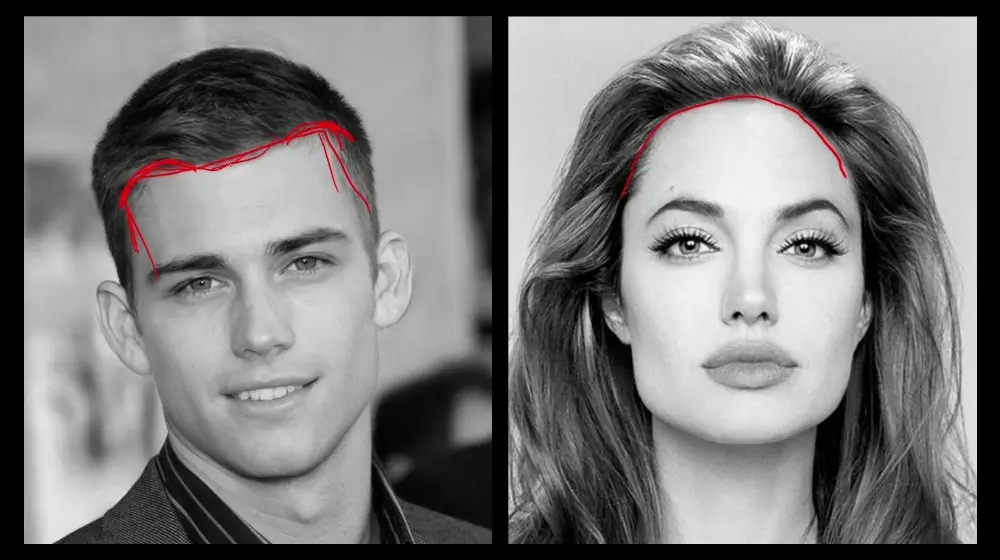
The hairline is another useful landmark, and it follows the same masculine/feminine pattern as the rest of the forehead: square hairlines are more common in men, while rounder hairlines are more common in women.

Male and Female Forehead img – 9

Rounded hairlines are more feminine, while squared hairlines look more masculine.

When calculating proportions, the length of the face is measured from the chin up to the hairline. However, as people age, the hairline may move backward, but that doesn’t change the forehead’s proportions. When sculpting a bald or balding subject, it often helps to imagine where the hairline would have been earlier in life.

Male and Female Forehead img – 10

The hairline is a landmark that defines the upper point of the face. However, hairlines change with age.

Bone structure determines whether a forehead looks more masculine or feminine – including the brow ridge, frontal eminences, and temporal lines. A moving landmark that also influences this is the hairline shape. Once you understand these landmarks, you can play around with masculinity or femininity freely.

This article only scratches the surface of what’s covered in our full Head Anatomy video course, where each of these landmarks is demonstrated on real faces, with more variation and case studies than we can fit into a written guide. If you want to go deeper into male vs. female forehead anatomy, check out the full course here.

Latest articles

forming the head blog for artists 1

Forming the Head: Simple to Complex

Form the head by starting with simple shapes and gradually add structure and detail. We cover base forms like the helmethead and egghead, first- and second-level blockouts, and the anatomy and variation that shape the head.

Read more

Join our newsletter

Be the first to get news about our upcoming discounts, books, tools, articles and more! No spam, just the good stuff.