Anatomy for artists​

This article will be useful for artists of any medium. We’ll look at the most common anatomy mistakes artists make and how to fix them, which parts to focus on and how to remember to improve anatomy in any future characters. And some general tips that would help with your sculpting, drawing, or organic 3D modeling practice.

Share post:

anatomy for artists by Anatomy For Sculptors 1

Table of contents

Anatomy tips for any medium - anatomy drawing, 3D artists, sculpting etc.

Regardless of whether you’re a sculptor, a painter, an animator, or sculpting 3D models digitally, there is a set of human anatomy principles that are relevant for every kind of visual artist.

Unlock the anatomical landmarks of the body

The skeleton is the part of the human anatomy many young artists tend to ignore. Why learn about the bones if you just want to sculpt or draw the muscles, right? However, if you only copy nature or images without any real understanding of the anatomy and anatomical landmarks of the body, you are bound to misinterpret a lot of things.

Ecorche bony landmark by Anatomy For Sculptors – 1

Visible in any body type

In addition to that, if you concentrate too much on the muscles when copying your reference material, you might miss a thing or two that are actually really important for your artwork to look real. Skeleton is the very foundation of the human body and it provides us with crucial information that allows us to depict the human form successfully.

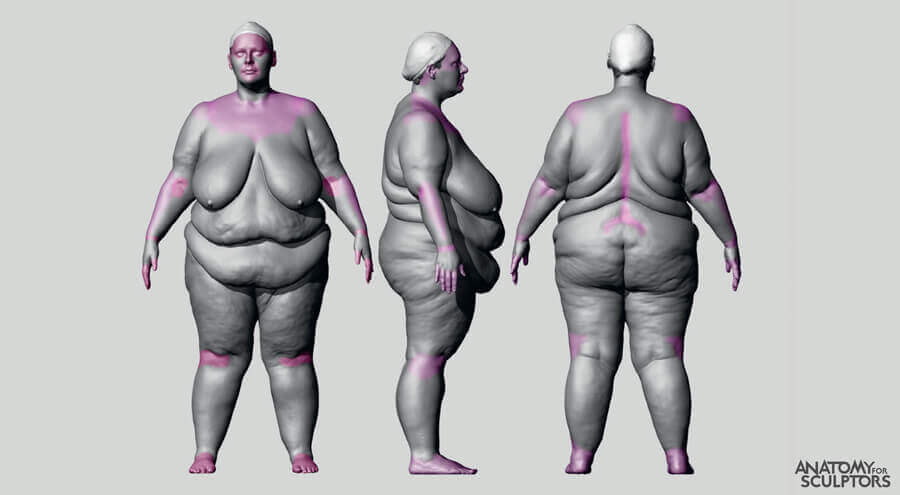
bodies less places that are less affected by body fat anatomy for

Areas of the body least affected by fat accumulation.
(from “Anatomy for Sculptors: Understanding the Human Figure”, p.62)

Get confident with body proportions

Body muscle and fat can vary dramatically from person to person, but a bodybuilder and a couch potato can have almost identical skeletons. That is why the skeleton is a very reliable reference point and can help with understanding body proportions.

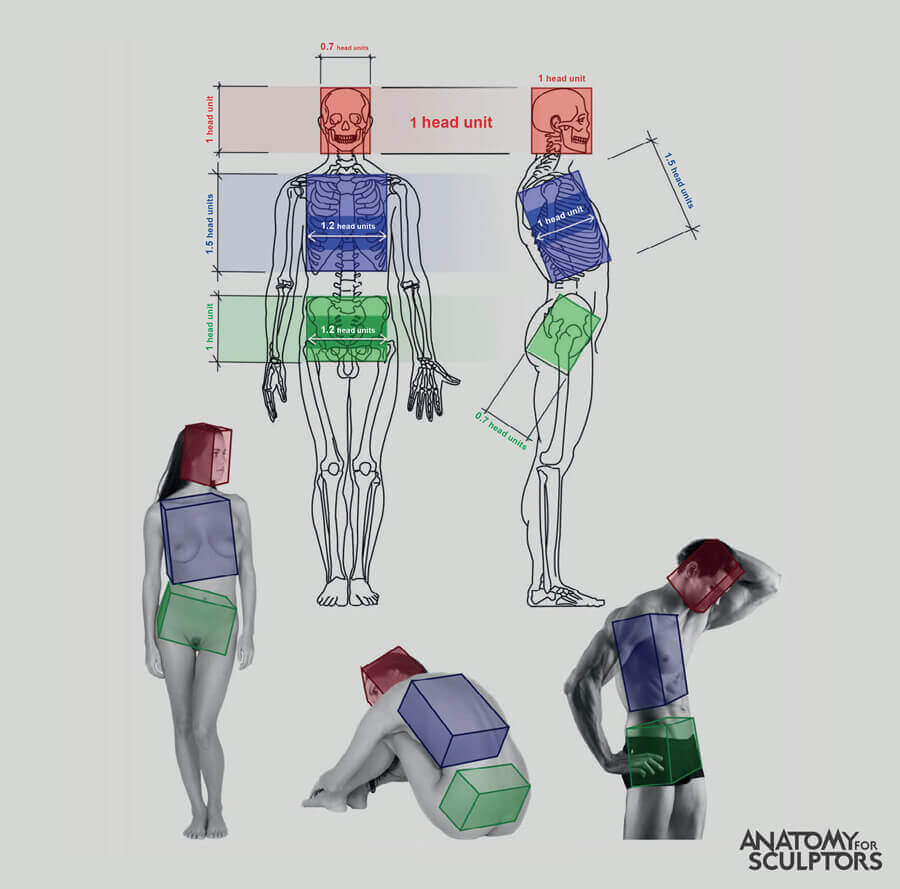
Take the human head, for example. The height of an average male will be about 7.5 times the height of that man’s head, and the rib cage of any person will always be as deep as their head is tall regardless of how much muscle and fat it will have.

The human body is also dotted with clearly visible bony landmarks like the back of the spine, collarbones, and elbows. These are helpful points from which to measure body proportions. They work much better than the fleshy landmarks like the navel, nipples, or the bottom of the buttocks. The skin is stretchy and can sag, so the person’s age and body type will impact their position.

human body units and proportions anatomy for

Human body proportions in head units.
(from “Anatomy for Sculptors: Understanding the Human Figure”, p.19)

If you strive to master human body proportions, be sure to check out our human body proportions calculator that we created as one of the goals of our Kickstarter campaign. It’s available right now! And it’s free to use!

The bony landmarks let us track the muscles

Remember those muscles you were so eager to sculpt and draw? Each of them actually has its origin and insertion points where they attach themselves to the skeleton. The origin is the point where the muscle attaches itself to the more central and stationary part of the body, and the insertion is the point where it binds to the more outer and movable part of the body.

A great exercise for practicing muscle placement is called anatomy tracing. You can start by tracing muscles on a reference photo and then when you’ve got the hang of it – turn it up a notch and try placing the forms of the muscles on top of a model of a human skeleton.

The knowledge of the skeleton and the bony landmarks make it easier for you to track the locations of muscles and understand their form. This makes it a lot easier to sculpt, draw, or model a realistic-looking bicep or a quad.

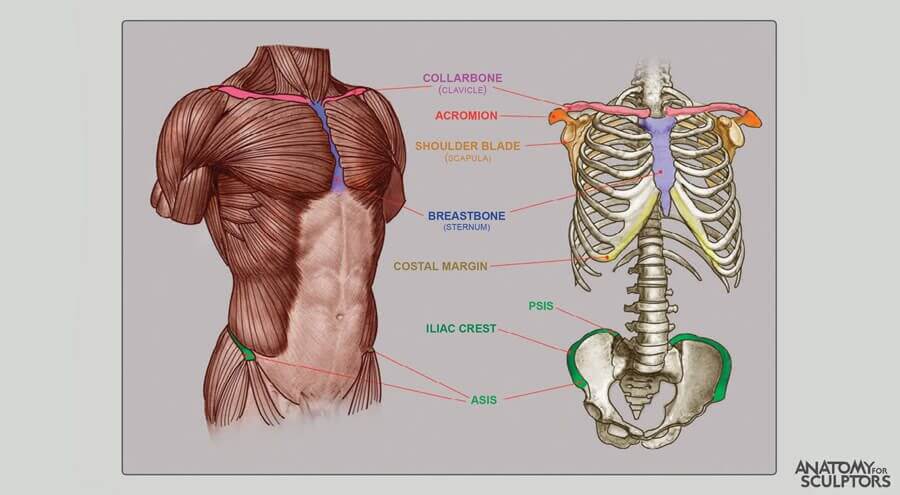
bony land marks of male body anatomy for

Bony landmarks on a male torso.
(from “Anatomy for Sculptors: Understanding the Human Figure”, p.11)

Understand joints in motion

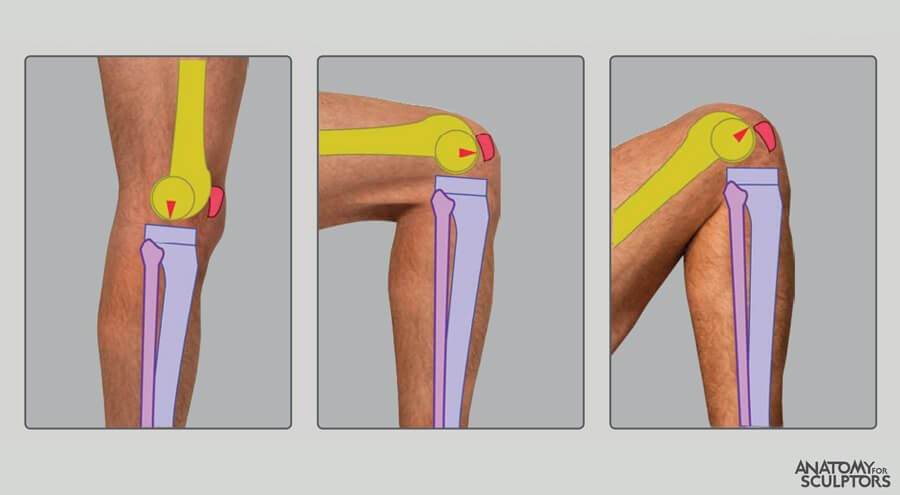
Understanding the human skeleton also means understanding the variety of joint types and their motion. That will help you figure out how to create convincing poses and how the motion transforms the surface forms. You will also learn the limits of the movement for each body part.

It was a rather complex task to render the correct anatomy and at the same time not to be too naturalistic and lose the aesthetic dimension.

knee mechanics anatomy for artists anatomy for

Knee joint mechanics.
(from “Anatomy for Sculptors: Understanding the Human Figure”, p.206)

We won’t go into details about body movement in this article. But it is good to know that there are 6 types of synovial joints found in the human body: hinge, pivot, ball & socket, ellipsoid, saddle, and plane.

There are also cartilaginous joints that are not that important for artists since they don’t move. (However, there is one exception – the spine.) Each joint type is able to perform a specific set of movements, and understanding them will help you depict body motion realistically.

Simplify muscles into simple shapes!

When sculpting or drawing a human figure, it’s not enough to just know and understand the human anatomy, it is equally important to know how to shape the surface forms of the muscles. To make this easier, artists break down the elements of the human body by using basic shapes. More on this topic on our “the elements of art form” article. 

arm and hand in motion book flex pose

How to study anatomy for art?

Finally, let’s look at some general advice on how to study anatomy for art and how to maximize the results of your studies and exercises. First of all – get ready to be very patient, create a lot and also fail a lot.

It’s not enough to just study an anatomy art reference

You might already have seen countless anatomy references for art. But it is not enough to just study anatomy. If that were the case, every doctor would be an amazing artist. Yet, they are mostly famous for their undecipherable handwriting.

Instead of just reading and listening about anatomy, you should sculpt, draw, sketch, model, and create as much as you can. That is the first condition for actually learning anatomy for visual artists.

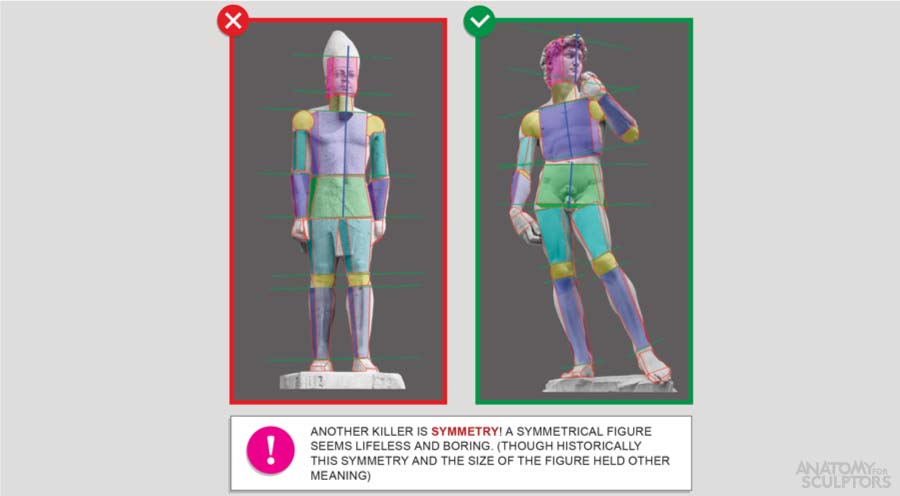
Symmetry symmetrical figure

The improvement after you follow the advice of your study buddies.
(from “Anatomy for Sculptors: Understanding the Human Figure”, p.15)

Sculpting and drawing exercises

We already mentioned anatomy tracing as a great exercise to start learning human anatomy. But whether you’re sculpting, drawing, or 3D modeling, the key to success is introducing variety in your exercises. Try creating while taking references from real life, other artworks, photos, sculptures, and your own imagination.

Training your brain is just like training a muscle in your body – it quickly gets used to the single exercise that you repeat and soon you’re no longer making progress. When you try a different approach, it allows your brain to process information in a different way and you learn more. Besides – diversity makes your sculpting, drawing, and modeling exercises more fun.

Learn the language of anatomy and technical art terms

This might not seem like such a big deal (and it is certainly not the most important thing for an artist to master) but knowing the language of anatomy and the technical art terms helps you a lot. When we become fluent in the language of anatomy, we also learn to think fluently about anatomy and creating. And you can find the right reference a lot faster.

Get modeling and drawing tips and tricks from your peers by sharing your work

Always evaluate what you’ve accomplished and share your artwork with friends, your teacher, or post it online. Your peers might make it easier for you to notice if something’s gone wrong. It is sometimes hard not to be defensive about your work, but remember that constructive criticism is helpful and benefits you.

When you’ve got the advice, follow through with it and make the corrections. As already mentioned – it is not enough to know what went wrong and just talk about it. You’re learning with your hands, through the process of creating.

Anatomy For Sculptors discord server! The invite link: https://discord.com/invite/Z6pRrqE9sW!

Latest articles

forming the head blog for artists 1

Forming the Head: Simple to Complex

Form the head by starting with simple shapes and gradually add structure and detail. We cover base forms like the helmethead and egghead, first- and second-level blockouts, and the anatomy and variation that shape the head.

Read more
3D anatomy models for artists blog

3D Anatomy models for artists

3D Reference Tool is much more than just a library of scans. Here, you will find 3D anatomy references – block-outs, anatomy models, and realistic assets – to help you understand and create realistic human anatomy.

Read more

Join our newsletter

Be the first to get news about our upcoming discounts, books, tools, articles and more! No spam, just the good stuff.